Coca-cola Zero. I recently tried this. Verdict: Much better than Diet Coke, but not necessarily better than Diet Coke with Lime.
Diet Rite Pure Zero cola. This is another new diet drink. It doesn't taste any better than the old Diet Rite, which is my favorite diet cola, in spite of its lack of caffeine. Bonus, the Diet Rite colas are sweetened with Splenda instead of aspartame. (If Splenda is killing us or taking our short term memory, we don't know about it yet. Or we've forgotten it.)
Air-adjust bed. Uncle Pookie just replaced our bed with one of those air-adjust bed sets--memory foam plus a layer of air, and you can adjust each side of the bed to a different firmness. It's surprisingly nice. Especially considering the price, which is less than a regular mattress and box springs.
The Rosary Shop. I just ordered some things from the Rosary Shop site, and I'm a happy customer. I received prompt emails confirming my order and its shipment, my order arrived well before I expected it, and everything I ordered was there. Moreover, they threw in a few extra supplies on the custom kit I ordered, and the instructions were very clear.
Joann's.Com. I ordered something from Joann's a week before I ordered from the Rosary Shop. I received an email saying they were going to process my order and that's the last I heard from them. I have yet to receive my order, which is now late, even allowing for the maximum probable shipping time they suggested. Fortunately, this wasn't a Christmas gift, so I can wait, but whereas I won't hesitate to order from the Rosary Shop again, I won't order from Joann's something I can get elsewhere.
The Christmas NRO. Good stuff. Lots of Christmas things. Because it's Christmas I forgive Amy Welborn for her piece, saying some things I wanted to say about Christmas....Eh, maybe I'll just say them anyway. Some things bear repeating.
Update/correction January 2006: The reason the Diet Rite cola I mentioned above doesn't taste any better than regular Diet Rite cola is that it IS regular Diet Rite cola. The Pure Zero thing, which I'd thought designated a second cola product, is now added to the labels of all the Diet Rite drinks. Diet Rite seems to be making a marketing push, improving all their labels and putting out refrigerator packs.
Thursday, December 22, 2005


How NOT to Make a Hogwarts Scarf
OR
How to Make a Hogwarts Scarf By Learning From My Mistakes
These instructions are for the Knifty Knitter knitting looms, but in making them I relied heavily on information I found at Atypically.Knit.
Of course you could make a Hogwarts scarf in just about any style, just by sticking to the house colors, but Hogwarts scarves, as shown in the Harry Potter movies, come in two basic varieties: the first kind, from movies 1 & 2, and a second style, from movies 3 & 4. The first style is basically nineteen equal-sized stripes of each house's colors, with eleven bunches of fringe in alternating colors at each end. Colors are bright. (For more detail and a knitting pattern see here. ) In movies 3 & 4, the scarves are made with the darker house color, with seven (more or less) instances of two narrow, light-color stripes placed near each other (what is called a trapped bar design); the exception is Hufflepuff house, which has the same design but in dark-on-light. These scarves have a short, dark fringe, and the colors overall are darker and more subdued than in the first two movies. (For more detail and a knitting pattern see here. For a crochet pattern see here.)(The fourth movie also contains what seems to be a general Hogwarts scarf--narrow stripes of house colors on a dark, probably grey, field.)
If, like me, you're new to the Knifty Knitter, either of these scarves will give you a lot of practice changing color, not to mention knitting over. Plus you'll have a fun HP scarf at the end.
For either style scarf, you will need...
*Worsted weight yarn in the colors of your preferred house. (Gryffindor--scarlet & gold; Ravenclaw--blue & either silver (movie) or bronze (book); Hufflepuff--yellow & black; Slytherin--green & silver.)
*The Red, or Child-size, Knifty Knitter Loom. (The red loom is 7" wide and will make a scarf that is just over 5 inches wide. If you want a wider scarf you could go with the green, adult-size loom, which I'm guessing will make a scarf about 7" wide.)*Yarn needle, scissors, knitting pick.
Hogwarts Scarf, First Style
I made a Gryffindor scarf. I used Red Heart Super Saver acrylic yarn in Gold and Mainstays acrylic in Autumn Red; the Red Heart SS in Burgundy also would have looked good. This yarn is cheap and worked well for this project. You can work 1 over 1 with it, so you don't even use much of the yarn; I had about a third of each skein (they were 7 oz.) left over. Of course if you want a more refined look, you'll need fancier yarn.Directions:
1.) Begin with your darker house color. Leaving a short tail, anchor your yarn and e-wrap all the way around twice. Anchor the end. Knit over. E-wrap again, anchor, and knit over. Repeat until you've knitted ten rows. Anchor your yarn and cut it; you should have a tail three or four inches long left.2.) Now you're going to change to your other color. Leaving a tail 3-4 inches long, anchor your new yarn and e-wrap all the way around. Anchor and knit over. When you've knitted all the way around, take the tails of both yarns and tie them together. Now you can continue wrapping and knitting over as before. When you have knitted ten rows of the second color, stop, and change color again.
3.) Keep repeating steps 1 & 2 until your scarf is the desired length. End with a dark stripe. (Optional: because you'll be "losing" a bit of length on each end to the fringe, you may want to make the first and last stripe one row longer than the other stripes. It's a tiny, anal retentive sort of thing and makes little difference.)
4.) Cast off. (I usually use the second flat removal method at Decor accents, but you can also single crochet to get your piece off the loom.)
5.) Turn your tube inside out. Take your yarn needle and weave in all the tails you left when you changed colors. Turn tube right side out.
6.) Find where you changed color; there will be a small uneveness in the stripe there. Align the color change rows down one side of your scarf.
7.) Optional (this isn't strictly necessary, but I did it and think it helps): Lay your scarf out nice and straight on a towel. Mist very slightly with a water bottle. Lay another towel on top, cover with books, and leave over night. It will be nice and flat and the color change rows will stay in place while you add your fringe.
8.) To make the fringe, wrap your darker yarn around a hardcover book (I used the second HP book) and wrap around it about 84 times. Cut the wrapped yarn at one edge of the book. Now wrap your lighter yarn about 70 times and cut. Organize your cut pieces of yarn into bundles of 7 strands each; you should have 12 dark bundles and 10 light bundles. To make your fringe, take a bundle and fold it in half. Poke a large crochet hook through both sides of your knitted tube and pull your bundle half way through. Stick the cut ends of the bundle through the curved end and pull; if you've ever made a tassel on the end of a bookmark, this is the same thing. Atypically.knit recommends doing your middle tassel first, then one on each end, then filling in. Don't forget to alternate colors, beginning and ending with your dark color.
Learn from my mistakes:
The movie scarf is 19 stripes, but my scarf was starting to look kind of long, so I stopped on 15 stripes. This turned out to be a little too short for me (I'm 5'7"), so I should have made at least 17 stripes or gone for the full 19 as planned; fifteen stripes would probably work fine for a child.I made the full number of tassels on each end, but 11 is too many for a scarf made on the red loom and they are pretty jammed on; nine tassels would work much better. Eleven would probably work fine with a scarf made on the green loom, plus the width on that would made a scarf closer to the movie width anyway.
About the scarf width, the red loom made the scarf a little more narrow than I thought it would. I think the width is fine even for adults, and for a child, it's probably the best size; a teenager or adult wanting a more "movie-accurate" look might want to go with the green loom.
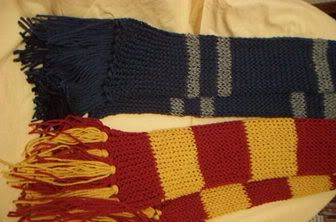
Hogwarts Scarf, Second Style
I made a Ravenclaw scarf of Caron Simply Soft yarn (see below) in Dark Country Blue and Gray Heather. This scarf takes very little of the second color.
Directions:
1.) Begin with your main color (the darker one, unless you're doing Hufflepuff). Leaving a short tail, anchor your yarn and e-wrap all the way around twice. (Depending on your yarn, you may need to wrap a third time; see below.) Anchor the end. Knit over. E-wrap again, anchor, and knit over. Repeat until you've knitted 16 rows. Anchor your yarn and cut it; you should have a tail three or four inches long left.2.) Now you're going to change to your accent color. Leaving a tail 3-4 inches long, anchor your new yarn and e-wrap all the way around. Anchor and knit over. When you've knitted all the way around, take the tails of both yarns and tie them together. E-wrap all the way around, anchor, and knit over. Cut your yarn, leaving a tail of 3-4 inches.
3.) Take your main color yarn, anchor it, and wrap all the way around. Anchor and knit over. Take the two tails and tie together. E-wrap again, anchor, and knit over. Repeat. Cut your yarn, leaving a tail.
4.) Take your accent color yarn and, leaving a tail, anchor it and e-wrap all around. Anchor and knit over. Take tails of yarn and tie together. E-wrap, anchor, and knit over. Cut your yarn, leaving a tail.
5.) Take your main color yarn, anchor it, and wrap all the way around. Anchor and knit over. Tie the two tails together. Continue wrapping and knitting over with your main color until you have 16 rows. Anchor your yarn and cut it, leaving a tail.
6.) Repeat steps #2-5 until your scarf is the desired length. (The movie scarves seem to have seven instances of the trapped bar design; I chose to stop mine after six.)
7.) Cast off.
8.) Turn your scarf inside out and use your yarn needle to weave in all the tails you left. Turn scarf right side out. Look for the row where you changed color, and make sure that row is aligned on one side all the way up. Optional: You can block the scarf as listed in step #7 of the first pattern above.
9.) To make the fringe, wrap your main color yarn around a book about 50 times. Cut the wrapped yarn along one edge of the book. Divide your yarn into little bundles of five strands each. Take a bundle and fold it in half. Poke a large crochet hook through both sides of your knitted tube and pull your bundle half way through. Stick the cut ends of the bundle through the curved end and pull. Atypically.knit recommends doing your middle tassel first, then one on each end, then filling in. When you have tassels across each end, you can trim to make a short, even fringe. (I decided I preferred mine long, but I don't think that's movie-accurate.)
Learn from my mistakes:
The Caron Simply Soft yarn does not work well on the Knifty Knitter. Its softer texture (usually a good thing) and lighter weight produces a loose-looking knit that is easily snagged. Experimenting since then, I've found that knitting 1-over-2 (wrap one extra time before knitting over) instead of 1-over-1 would fix most of the problem with the Simply Soft yarn. I recommend just using another yarn.I made my light color stripes and the dark bar between the stripes one row longer than I had intended to, and it is too wide. They don't look right. (I've given the "correct" way in the directions.)
I didn't use good sense. I saw shortly after I started that the Simply Soft yarn wasn't working. I should have pulled it apart and tried 1-over-2 then or went and got a different kind of yarn, but I didn't listen to that little voice playing spokesman for my better judgement. I made the stripes a row wider than I had intended to do because, while making the first one, I had an attack of doubt and changed my plan; but by the time I'd made a couple of the stripes I could see they were too wide--my original plan had been right after all--but instead of pulling those out and starting over, I just kept on with what I was doing. Like I said, there was a lack of good sense.
Like with the first style scarf, if you want a scarf that looks as wide as in the movies, you may want to try moving up to the green loom.
A mistake I made with both scarves was to spread them out on the back of my couch to look at, and then went away and left them for a while. When I came back, our cat had walked all over them and was now happily napping on them. I don't recommend letting your cat walk on your scarves; whether you let it nap on them or not depends on how you feel about cat hair, your cat's comfort, and, I suppose, the scarves themselves.
Oh, and a further note on my Hogwarts scarf-making experience: As I had plenty of the Simply Soft yarn left and as that blue color is really nice, especially with Uncle Pookie's coloring, I decided I was getting a scarf out of it. I crocheted a second Ravenclaw scarf, a la Luvtocraft. (It's all double crochet, so it's easy.) To my crochet-novice eyes, it looks great, and I've already insisted Uncle Pookie wear it out. In our warm climate, scarves are mostly decorative and men rarely wear them, but Uncle Pookie is confident in his masculinity (or is that his feminine side?) and, as I pointed out, if anyone bandies about the word fruity when they see his scarf, we can remind them that John Wayne often wore fancy neckerchiefs in his movies and no one said a thing. (He wore bracelets too.) The Simply Soft, incidentally, crochets very nicely.
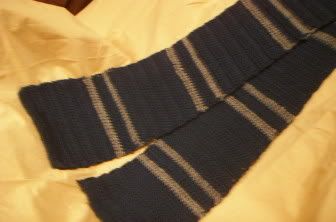
If anyone uses these instructions, or is inspired by them to come up with a better Knifty Knitter Hogwarts pattern, I'd love to hear about it.
Tuesday, December 20, 2005
Homespun Scarf On the Knifty Knitter
I've made three of these scarves--the two pictured for me and one for my sister. They take longer to make than a straight knitted (on the KK loom) scarf would, but they lie flat without blocking and the technique, though simple, really shows off the wavy texture of the Homespun yarn. The colors I used are Edwardian and Ranch.

They are really simple, but as there aren't many Knifty Knitter patterns out there, I thought some people might be interested.
What you'll need:
Lion Brand Homespun Yarn (or similar), in your preferred color; at least half a skein.
The blue Knifty Knitter loom.
And, obviously, a yarn needle and scissors.
Directions:
Basically, what you're going to do is knit one row and purl the next.
1.) Leaving a tail of about six inches, anchor your yarn.
2.) Do an e-wrap on the first fourteen (14) pegs. At the fourteenth peg circle back again and go back, e-wrapping the pegs the other way. Each peg is now wrapped twice. Anchor your yarn. Take your Knifty Knitter tool or other hook and, starting at the fourteenth peg, knit over--i.e. lift the bottom yarn over the top.
3.) When you get back to the first peg, take your yarn and hold it in front of the pegs. Using your hook, reach under the loop that is on the first peg, take up the loose yarn lying beneath it, and pull upward so you have a new loop. Use your fingers to lift the old loop off the peg and replace it with the new loop. Gently pull on the end of the yarn, to take up some of the slack. (If this is hard to visualize, you can watch a short video of it at Decor Accents.) Repeat process with each peg until you get to the fourteenth peg.
4.) Wrap the last peg and wrap back over previous pegs as before. Knit over.
5.) Repeat steps 3 & 4 until scarf is desired length. (Mine are about 5 feet.)
6.) Remove the scarf from the loom. I did this by slipping the last--the 14th--loop onto a crochet hook, making one chain stitch from the loose yarn, then making the next chain by slipping the next loop of its peg, and continuing alternating like that until all the loops are off the pegs. Decor Accents has pictures of this method.
7.) Leaving a tail of about six inches, cut your yarn. Thread the yarn into your needle and weave in ends. Do the same for the tail left at the beginning of your scarf.
Like I said, simple. You can do it while watching DVDs, provided you don't have to read subtitles.
The Capes Will Rise Again
I've long wished for a return of capes/cloaks/drapey wraps to ordinary life, because they're just so cool-looking. Admittedly, jackets and coats do a better job of keeping people warm, but they can't compete with capes for style (a few really cool-looking examples, such as Spike's leather trophy coat on Buffy, notwithstanding.) If you live in an area with mild winters, you don't need the warmest possible clothing. What I'm saying is, it's time for the Deep South to revive the cape!
I've started doing my part already. Late fall or early winter of last year I made a ruana and wore it all winter. "Ruana", for anyone who doesn't know, could be considered a fancy word for "a poncho split up the front", but I don't like ponchos and I do like ruanas. They are very easy to make; my first one was just a cut-and-wear one of brown fleece, but when I pulled it out to wear when the weather turned nippy last week, I got a compliment on it from a fellow shopper who told me she wanted to make a cape and was looking for ideas, so I figure it can't look too bad. This is somewhat in contrast to last year, when the first time I wore it Uncle Pookie told me I was wearing a blanket; of course when I pointed out I could hide a gun under it, the way Mexicans or seeming Mexicans sometimes did under ponchos in Westerns, the advantages of such a garment became obvious.... Hmm, maybe, just for the record, I should point out I'm not planning on shooting anyone, much less staging an elaborate trap, complete with apparently snoozing Mexicans, for my enemies any time soon?
I got the directions for how to make a ruana--and the word, which I'd never heard before--from a library book on plus-sized dressing that I skimmed back in the '90s. The author recommended ruanas for super-sized people who have difficulty finding coats, but they're nice for anybody. I would credit the book's author, but I can't remember the title or author's name; I wouldn't remember the book at all if I hadn't taken notice of the ruana project. Since then I've seen directions for a ruana in Pattern-free Fashions, by Mary Lee Trees Cole, and I just saw the very similar "wrap cape" from Nancy Zieman at Sewing.org .
The measurements below should fit most adults, but they could easily be changed to fit especially petite women or children.
How to Make a Ruana--A No-Sew or Low-Sew Project

For a no-sew ruana, take two yards of a non-ravelling, 60"-wide fabric, such as Polar fleece, and make sure the end edges are trimmed straight across. Fold the fabric in half, so that it is 60" wide and one yard long; where the fold is is where the shoulder line of your ruana will be. Measure over 30" and mark with chalk the middle of the fabric both on the fold and at the bottom of the top layer. Draw a line between the two marks; this will be the front opening of your ruana. At the top, where the fold is, draw a line 6 inches wide; center it, so you have 3 inches on each side of your center front line. Now, take a bowl or plate and chalk a curved line from each side of the neck opening to the center front opening, so that the top front of your ruana curves a bit, rather than meeting in a square; it will hang better this way.
Double check to make sure everything you've marked looks right. Now get your scissors and carefully cut along your chalked lines, straight up the front of your top layer and then across at each side of the neck. (If you want to use a rotary cutter, spread the fabric out before cutting.) If desired, also round the bottom corners of your ruana at this time. Ta-da! You have a ruana. Wear it hanging down like a cape or throw one end over the opposite shoulder.
No-sew variations, other than curving every corner, could include cutting the bottoms into fringe or changing the length. Also, because the sides of the neck opening get a little more stress than the other cut places, I put a dot of Fray Check on each side; this was probably wholly unnecessary.
This becomes a low-sew, instead of a no-sew, project if you want to add embellishments, such as applique or decorative edge stitching, or if you use woven fabric. Obviously, if you use woven fabric instead of a non-ravelling knit, you're going to have to bind the edges somehow to prevent ravelling. My second ruana, which I made a month or two ago, was of a woven fabric. I bound the edges with black double-fold bias tape, to go with the black-and-white check of the main fabric. It looks great, except for one thing. I was so busy grumbling to myself about how I had to cut out fabric on the dining room floor (long story) that I forgot the cardinal rule of "measure twice, cut once"; actually I'm not even positive I measured once. (It's amazing how often irritation goeth before a fall.) Somehow I let my folded fabric be more than a yard long, and then when you add the way the weight of this fabric makes it drape, it is much too long. Unless I decide I like it this way (not likely) or get up the energy to rip out over thirty feet of bias tape (black thread on black fabric, an optometrist's dream), this ruana may remain sitting in my closet. But whatever I decide to do with it, it won't be my last ruana.
Update January 2006: This isn't anywhere near being important, but since writing this I have discovered, through the necessity-is-the-mother-of-invention method of needing something to jazz up an outfit, I can wear the black and white ruana I mentioned above, provided I wear one front end draped over the opposite shoulder. It would still look better shorter, but this is nice enough. The black binding creates pleasing lines when it's draped this way.
Sunday, December 18, 2005
What Do You Eat When You're Alone?
There is a wonderful cook book called Home Cooking, by Laurie Colwin; this is one of those that can be read with pleasure by people who don't cook, because the true value of it is not the recipes (though the ones I've tried are good) but the pleasure to be found in its writing. The recipes are embedded in chapters that sometimes have titles like "How to Disguise Vegetables" or "Repulsive Dinners: A Memoir". I've read most of these chapters more than once, and occasionally find myself thinking about something from them. Like this, from the section called "Alone in the Kitchen with An Eggplant":
Yesterday I ate lunch at home alone. I squeezed half a boudin (a kind of Cajun sausage, made of rice, meat, and spices; it's sometimes spelled boudain) out of its membrane, mixed it with an egg, dropped it by spoonfuls into a skillet, fried it, and ate the resulting patties with a tablespoon of ketchup that had two drops of hot sauce mixed in. This is possibly some sort of Cajun blasphemy, I don't know. But it wasn't bad.
What do you eat when you're alone?
"Dinner alone is one of life's pleasures. Certainly cooking for oneself
reveals man at his weirdest. People lie when you ask them what they eat when
they are alone. A salad, they tell you. But when you persist, they confess to
peanut butter and bacon sandwiches deep fried and eaten with hot sauce, or
spaghetti with butter and grape jam."
Yesterday I ate lunch at home alone. I squeezed half a boudin (a kind of Cajun sausage, made of rice, meat, and spices; it's sometimes spelled boudain) out of its membrane, mixed it with an egg, dropped it by spoonfuls into a skillet, fried it, and ate the resulting patties with a tablespoon of ketchup that had two drops of hot sauce mixed in. This is possibly some sort of Cajun blasphemy, I don't know. But it wasn't bad.
What do you eat when you're alone?
Wednesday, December 14, 2005
Some Fun Stuff
I've managed to waste more time than I thought I had to waste online lately, so here's some fun stuff I found.
Find Your Hogwarts House Personality Test
I'm not as much of a personality test junkie as I used to be (I guess I find myself less fascinating than I did when I was younger), but I liked this one. This would be a fun test even if you knew nothing about Harry Potter, because the questions make you have to think. I didn't save my results but they were 95 Ravenclaw, around 78 Hufflepuff, high 50s Gryffindor, and 29 Slytherin.
The Haggis Hurl game.
And from the site that linked the Haggis Hurl, I've Got My Tinfoil Hat On.
This has been around for a while, but it's new to me: Yatta. It's no Numa Numa , of course, but it's cheerful in its own Japanese-men-dancing-around-in-their-underwear-and-fake-fig-leaves-kind-of-way.
I had to have some Seinfeld quotes for my sister's Christmas--sorry, Festivus--gift, and rather than trusting my memory I looked for them online. (It also saved typing them all out.) Imdb.com had a truckload. If you enjoyed Seinfeld, it's actually kind of fun to go through them. But it's no Yatta.
Some Good Lines I've Heard Or Read This Past Month Or So
"The conservative man knows our society needs good mothers way more than it needs hot movie stars who don't sag in their thirties." (Tim Graham)
"... f***ing with the PTA in Japan is like f***ing with The Sopranos." (Azrael, of I Am a Japanese Schoolteacher)
"If I am truly unbiased [as a journalist], then I need to get used to this one simple fact; that the untold story, might in fact, be a positive one." (Margaret Freidenauer, embedded reporter)
"If you don't look good on wood, you shouldn't become a Christian. This [pointing to crucifix] is not for sissies." (Michael Cumbie, Catholic evangelist)
"While he needed a sophisticated basic education to be Shakespeare, the author of the plays, a university training, at least with regard to medicine, would have diminished rather than enhanced his work....As Orwell pointed out, it takes effort and determination to see what is in front of one’s face. Among the efforts required is the discarding of the lenses of excessive or bogus theorizing. When it comes to our attempts to understand the phenomena of our own society, I cannot help but wonder how many of us are in the grip of theories that are the equivalent of Hall’s Galenical theory, and whether as a result we do not prescribe the legislative equivalents of human skull, mummy dust, and jaw of pike." (Theodore Dalrymple--if this doesn't make sense, here's the rest for context )
"Money can do a lot of things - but it cannot help reconcile you to your own death." (Umberto Eco)
Lagniappe for the Soul
I was thinking about the "Catholic double dipping" I wrote about in my last post, and I thought maybe another way to talk about it is as "lagniappe for the soul"--asking for one thing (a blessing for someone else) and getting something extra.
Tuesday, December 13, 2005
The Catholic Home, by Meredith Gould
Anyone who still has a gift to buy for a Catholic friend or relative may want to check out this little book: The Catholic Home, by Meredith Gould, published last year by Doubleday. It's subtitled Celebrations and Traditions for Holidays, Feast Days, and Every Day and that pretty much tells you what it is--a nice mix of folk customs and some Church teaching to help people (especially those of us who did not grow up with all the once-common traditions that marked a Catholic household as Catholic) to celebrate the liturgical year. There's a lot of ideas here, so it's well worth the price (under US$20). If you've already done your Christmas shopping, keep this in mind as a gift for people who are about to get married or who have a baby; it would make a great gift for people starting a new home and family.
Caveats: I haven't read every single page--it's more of a dip-into book than a read-straight-through book--and I did find an error in the Advent section. The author says that Advent begins November 30th; later in the book she says St. Andrew's Day (November 30th) marks the end of Ordinary Time . This is not quite true, although every Advent calendar I've ever seen for sale starts its numbering on December 1. My understanding is that Advent begins four Sundays before Christmas Day. This means that the start of Advent varies year-to-year, and that the earliest Advent can begin is November 27th (like this year) and the latest is December 3rd (unless I've miscalculated.) And I suppose anyone could find something in the book to quibble with--I associate Santa Claus more with Odin than with Thor, for example--but don't let any of this prevent you from buying the book, for yourself or others. Whoever gets it will probably enjoy it.
Oh, and by the way I noted with amusement that the author uses the term "double dipping" when she mentioned people can receive Anointing of the Sick (what used to be called Last Rites) more than once. I use the term "Catholic double dipping" for the practice of praying for others; we believe that praying for others benefits both the person prayed for and the person doing the praying--the latter because praying for others is an act of charity and like any act of charity can help open the heart further--so it's like opening two avenues for grace.
Monday, December 12, 2005
Random Thoughts
***
Considering her problem with water, the Wicked Witch of the West must have smelled worse than her flying monkeys.
***
I was in the dollar store recently and saw one of those children's illustrated classics versions of, get this, George Bernard Shaw's Pygmalion. Now I actually did read Pygmalion as a child, but I'll be the first to admit I was not the most normal kid on on the block. It's not a children's play.
***
Squirrels might seem less cute to us if we called them tree rats.
***
People say the sense of wonder diminishes with adulthood, but between going into the living room and wondering what I went in there for and leaving the kitchen and wondering if I remembered to turn off the stove, I'm more full of wonder than ever....Okay, that's so corny I should apologize. I'm sorry. It's still true though.
***
It's probably easier and less distracting for childless women in their thirties to go to Unitarian, ultra-liberal Episcopalian, or other churches where the birth rate is likely to be a bit low, than to go to "conservative" Catholic or evangelical Protestant churches.
***
I'd be willing to bet a few dollars that none of the celebrities saying Tookie Williams shouldn't be put to death because he has supposedly redeemed himself and is all about peace nowadays would want the man living next door to them or babysitting their children.
***
Why is it easy--relatively easy--to get up early to go to work or to school or on a trip, but so incredibly hard to get up early to exercise?
***
The funny, talented Richard Pryor has died. Since Richard Pryor's enjoyment of his last years was (I assume) diminished by his multiple sclerosis, it seems sad that he missed so much of his time in the preceding years due to being high. But then it's sad that many of our most creative people are unhappy enough to want to spend much of their non-working time high or drunk or otherwise pursuing self-destruction. I wish I knew why so many creative people are unhappy.
***
Yesterday at Mass
Today is the Feast of Our Lady of Guadalupe, and yesterday at mass there was a short procession with a Guadalupe statue, children carrying candles, and the Blessed Sacrament under a canopy that looked kind of like the huppah at Jewish weddings. As I stood in the procession, my throat kept swelling up with emotion, and I was afraid of crying. Catholics have been doing this--having processions with statues on feast days--since at least the Middle Ages, and there I was, a part of this tradition that so many people have taken part in all over the world. I may have been in a modern parking lot in America, wearing modern clothes and no doubt holding a lot of modern ideas, but I was connected to Catholics from hundreds of years ago, as well as Catholics in other parts of the world today--especially in Mexico, where Our Lady of Guadalupe is most loved. I was connected to all of them, and it was good.
At least I think that's why I was so moved.
At least I think that's why I was so moved.
Post-Katrina Update (Kind of Long and Possibly Boring)
Thursday was the Feast of the Immaculate Conception, a day of holy obligation for Catholics, and I got a pleasant surprise when I went to church: we had mass in the church building. Since Hurricane Katrina we've had to have mass in the parish hall, because the storm ripped our roof off and before it could be fixed mold got in the building and people had to come in and dry it out (if you've never seen this, picture a massive dryer vent tube hooked up to a machine and going in the front door) before it could be properly cleaned and repainted. (We're lucky; some churches in the diocese were destroyed.) The mass is the mass whether it's celebrated in a grand cathedral or secretly in a jail cell in communist China, but I don't mind admitting I prefer our pretty sanctuary and padded kneelers to folding chairs and no visible tabernacle in the parish hall.
This was another step toward everything being back to normal for people who go to my church, but, however much better things are--and they are vastly better--things still aren't completely normal in south Mississippi. I came across this page of readers' post-Katrina updates at Amy Wellborn's excellent site (I haven't had time to look at any blog other than The Corner in about a month and a half, but I saw this when I followed a Corner link; she also had an interesting Pullman review ) and I thought an update about people who aren't directly on the Coast might be of interest to some. I can't offer official statistics or anything, only give an idea of what an average person sees.
I live in south Mississippi, about thirty miles inland. Our town was lucky. We never lost water, there was no flooding, we got power and community services back relatively quickly, and hardly any businesses had to close, although some took a while to reopen. All the massive piles of debris (mostly parts of trees) that had been in front of every house and, in some places, piled in the medians are now long gone, but here and there around town there are still a few downed trees in people's yards that haven't been taken care of; more common are damaged trees--for example, leaning badly but not fallen--that haven't been taken care of. Many yards still have holes or big bare dirt areas where trees were pulled out. I've seen roofers working just about every Sunday, not to mention weekdays, but there are still "blue roofs" (a kind of tarp-like thing that FEMA gives out) on houses all over town. There's a lot of trailers and RVs in town, some of them sitting in people's fronts yards; I haven't seen any tents lately, though. Thanksgiving Day there seemed to be an abnormally large number of people at Wal-Mart or eating out; my guess is people living in FEMA trailers found staying at their temporary homes on a holiday depressing. There are a few buildings with severe damage that haven't been--or can't be--fixed and aren't yet torn down. Last I noticed the banks of free phones that the phone company put up in several places around town were still up and the public library still had a sign up saying computer use was now limited to help with Katrina-related issues.
The biggest change in southern Mississippi is the change in population. People have moved off the MS Coast or out of southern Louisiana into more northerly parts of southern MS and LA. The town I live in not only has new residents but is close enough to the coast and to still-damaged parts of Louisiana that we have people from there coming here to shop. So there's a lot more traffic in town. The parking lot of the local Wal-Mart looked like it was Christmas shopping season back in October; now that it is Christmas, it's insane--full parking lot and lines at every register at 9AM on a Tuesday morning. It's a Supercenter, but, not having enough personnel to cope with the increased volume, they still haven't been able to go back to the normal 24-hour a day schedule. Wal-Mart is the busiest, but the story is much the same all over town, especially at the dollar stores. Business has increased so much it's often hard for the store employees to keep everything organized and provide their usual level of customer service. They've mostly adjusted to the increased volume, but for a long while there the stores had trouble keeping shelves stocked--especially cleaning supplies.
On a sociological note, there's suddenly Hispanic people in town, where before this was a white-&-black-with-a-handful-of-Asians town. It's mostly Mexican men, who I assume are here for work; a lot of the new residents aren't displaced people, but workers who've come in for the various clean-up and rebuilding jobs.
The only other town I know much about is Hattiesburg, which is about seventy miles inland. I've been told it has an additional twenty thousand people in town since Katrina--this is on roads that were called thirty years out of date for the level of population ten years ago. I know someone who had a sudden need for housing there in November and couldn't find a hotel room anywhere in town, and discovered that, even though Hattiesburg has apartment buildings everywhere you turn, available apartments were scarcer than hen's teeth. So Hattiesburg has had to cope with a lot of new people in town--with its attendant demands on schools, police, sewers, etc.--in addition to their own hurricane damage, which wasn't inconsiderable; a few weeks after the hurricane I happened to ride by the place where they were stacking trees that had been removed from roads and such, and it was amazing--aisles of piles of trees as far back as I could see.
(To return to the Hispanic note, Hattiesburg does have an Hispanic population, and I heard they were badly hit by the storm. Few speak much English, so it was hard for them to get information afterward, not being able to understand the radio or read newspapers or flyers. Most don't work the kind of jobs that are likely to give pay for any of the days of work missed because of the storm. And some were probably reluctant to go for help to anywhere that might be government-related because, let's be honest, a lot of them aren't legal. The local Catholic churches provided a lot of help though, and I don't doubt other groups did as well; I know a relative of mine was picking up free lunches at a Baptist church--a lot of churches gave out food after the storm--and driving them to a badly affected Mexican family who lived down the road.)
So far I haven't heard of any conflict of the sort one might expect when a town has a sudden influx of people from outside. The closest to that kind of thing I know about was a bit of bathroom graffitti I saw that went, "[name of town] sucks!" and the response "[something insulting] go home!" I guess there isn't conflict because these towns around here that have displaced people are close enough by that the displaced people don't stand out--they're basically the same culturally and may in fact have relatives in their new town. I wonder if it's the same in the towns in other parts of the country that took in a lot of displaced New Orleans residents?
My husband and I visit Lousiana fairly often, Slidell mostly. (Slidell is a town north of New Orleans; the Onion's list of top ten things under New Orleans' flood waters included Slidell.) The traffic situation is the same in LA as in southern MS. Slidell is crazy though. There was flooding and things are less normal there than in MS-- non-Coast MS, anyway. Everywhere you go in Slidell--every single store, every single restaurant--has "Help Wanted" signs up and have for over two months. Some of the fast food places are offering signing bonuses. There's lots of people on the roads and patronising the businesses, but not enough people to work. So you'll see odd stuff like a Taco Bell that closes at five in the afternoon because there aren't enough workers to keep it open. I really don't know what's going on there. Also some places still haven't reopened because of flood damage, but you can see signs of work going on, so I guess it's only a matter of time.
We still haven't visited the MS Coast since Katrina. People who have say it's still really messed up and there's still some roads that are closed.
Thursday, December 01, 2005
Odds & Ends
Auntie Suzanne has been brought low by her own traitorous body--first by a cold last week, and then by her sinuses' insistence on giving her a headache every day this week--but she has managed to see a few interesting things online.
Popular Science is riding through town tellings us, "Colored bubbles are coming, colored bubbles are coming!" Actually they just have an interesting article up about one man's quest to create colored bubbles. With eleven years, a fair amount of funding, and the services of a dye chemist, that one man succeeded, and we should have non-staining, colored bubbles on the market no later than February. Because the creation of the bubbles involved creating an entirely new class of dyes, there's potential for a lot of other new products, such as temporary wall paint colors or toothpaste that will stain kids teeth until it's time for them to stop brushing.
They also have a list of the 10 worst jobs in science up that is kind of fun to skim through, but I don't think any of the jobs on that list are worse than working retail during the Christmas season.
Uncle Pookie and I read Freakonomics a few weeks ago, and although the book was entertaining reading, I didn't buy the legalized abortion caused the drop in American crime theory. It was not that I had a problem with saying legal abortion might have some good side effects, but that I didn't buy it as the cause. I believe the drop in crime is due primarily to the fact that we have a smaller percentage of young people in our society now; any time there is a larger percentage of young people in a society, there is more crime, because young people--especially young men--are much more likely to commit or be involved in crimes than older people. (FWIW, they are also more likely to be the victims of crimes, largely because of their tendency to hang out with other young people.) I saw no problem with saying legalized abortion may have contributed to the reduction in crime rate, because anything that results in fewer teenagers and young adults in the population reduces crime; I just figured the birth control pill contributed at least as much as abortion did, and that the change in attitudes that made us want fewer children and want them later in life when it's harder to make them was the biggest contributor of all.
Not being a social scientist, I didn't--and don't--have any data to back my opinion up, but according to Steve Sailer there is evidence that the Freakonomics abortion-cuts-crime argument is seriously flawed. (Link via The Corner.) I'm not going to try to summarize his summary of the problem, but it's worth a skim, because with the popularity of the book, we're likely to hear this argument a lot.
And just for fun, Foamy's Christmas Rant is back up. This was my introduction to Foamy, and I still find it really funny. Be warned, it is definitely NOT work-safe or children-in-the-room-safe.
Monday, November 28, 2005
The New Harry Potter Movie
Thomas Hibbs had a review of sorts of Harry Potter and the Goblet of Fire (it's also about the new Pride & Prejudice movie and how both relate to virtue) on NRO today. It reminded me I haven't posted about GoF, even though I saw it last Monday.
In a word, fantastic. Well, maybe that's a bit much, but it is really enjoyable and the special effects are great. The only disappointment in my moviegoing experience was that I didn't finish our Hogwarts house scarves beforehand so we could wear them to see the movie; that probably means I'm turning into a big old dork.
Some points:
- The movie starts off with so many great-looking effects right in a row that I wondered for a split second if there'd be any story or if they just meant to distract us with special effects; there is a story and the film continues to look good.
- This movie might be too scary for really young children, possibly even ones who've read the book; reading a book gives the individual some control over the imagery, whereas a movie can't. Also in one or two spots the movie is darker than the book; the most important is the changing of the Death Eater march after the World Cup.
- They had to leave a lot out of this movie. There's no Dursleys, no Winkie, no House Elf Liberation Front. It makes me wonder how they'll fit all of The Order of the Phoenix in; one way, which I think we can safely say won't happen, would be doing it in two movies, part one and part two, like Kill Bill.
- Anyone who hasn't read the books may be left slightly confused in one or two places, but over nothing major, unless the change in the Death Eater march made them think the DEs were already working with Voldemort.
- They really should have made these movies faster. The kids are already looking too old for fourteen; with the next one scheduled for 2007, the kids definitely aren't going to look fifteen.
- For the first time, their having cast a pretty girl in Hermione's part mattered. The scene at the ball, when people see Hermione and say she looks beautiful, loses most of its point if Hermione was pretty beforehand.
- Dumbledore shouldn't have grabbed Harry like that, after the choosing of the champions. It was dramatic and the action would have been reasonable in most people, but it just wasn't Dumbledore, so it took me out of the movie for a moment.
- This movie led to a new experience for me. The friend we saw GoF with had a question about one of the actors, so after the movie I was looking the answer up on Internet Movie Database and I saw the actor who played Krum was born in 1985. For a moment I felt like a dirty old lady. I'd been thinking Movie Krum was kind of hot. Sanity returned a moment later when I realized, appallingly recent birthdate or not, he's physically a man, so I'm not a pervert. But before this it had never occurred to me women could feel like the female equivalent of the dirty old man.
Friday, November 25, 2005
'Tis pity she's a person of negotiable affection...
Why are so many people nowadays so obsessed with whoring? It's as if no girl nowadays can say, "I like yarn" or "I really enjoy cookies"; no, it's "I'm a yarn whore" or "I'm a cookie whore." And don't even get me started on the fact that a large segment of the American population now uses the term "pimp" to refer to good, or at least innocuous, things.
Is it that the consumeristic, materialistic mindset has now been carried so far people no longer mind admitting they are for sale--and for cheap too. And does the same materialistic mindset mean they see no longer see any reason even to pretend to find exploiting people wrong? If that's so, why not go the whole hog and start talking about being a "yarn slave" and "slavemastering your 'ride'"?
Are some of them trying to shock people? If so it's not working, because everybody says it; maybe they could get a reaction if they talked about "lynching" instead of "pimping".
Or is all the whore and pimp talk just rampant crudity and no one using it is thinking about what they're saying?
Probably.
But I wonder if the whore thing--and the slut thing, too, as "slut" is used a lot and in a similar way-- isn't part of our modern anti-goodness. People nowadays are less apt to believe in goodness. When we see it depicted in fiction, we scoff at it; when we see it in life, we suspect it; when we hear it promoted, we mock it. We want our heroes not just
"warts and all", but nearly all wart; a strangely large number of us now prefer villains. Maybe this whore thing is a related phenomenon? People don't believe in virtue any more, but think if it did exist, it wouldn't be egalitarian to reach for it, so we're all more in tune with the times if we embrace vice instead. No girl believes in the idea of or wants to be a lady, but any girl can call herself a whore or a slut, and who's going to contradict her?
It's probably just crudity. But whatever it is, crudity or sign of deeper problems, couldn't people at least mix it up a little--say "pander" or "procuror" occasionally instead of "pimp", throw maybe an occasional "prostitute" or "madam" or "bawd" in there; I have seen a "harlot" or two, but that doesn't provide much variety. Even crudity needs originality! Get with it all you yarn/cookie/whatever cathouse denizens--pander your language!
And while you're doing that, maybe you could come up with some sort of ranking for the various whores? Just so we know where we are. I mean, is a two-skein whore the high-priced yarn whore or the cheap one? Do cookie whores come in two-chip versus blue-chip varieties, or is it a chip versus chunk scale? I just want to know so I don't inadvertently insult someone by suggesting her price is lower than it is--say calling a woman a styrofoam cup of instant Folgers whore when she's really more of an overpriced espresso kind of whore.
Thursday, November 24, 2005
Some Other Things To Be Thankful For
Hygiene. Soap and water are cheap and plentiful in our society. We no longer get diseases from filth in the street or doctors not washing their hands before surgery.
Relative lack of pollution. It's not just that we no longer leave human or transport animal waste in the streets, but that in the last forty years we've cleaned up the emissions of our factories and cars so much that, even with more people and more cars, the air is cleaner.
Public libraries. I have no idea what libertarians think of them and I'm not usually much on government funding of non-necessities, but I love the fact that even poor children in America can go into a public library and check out books. It feels like taking away treasure, just on the promise you'll bring it back in two weeks.
Supermarkets and all-you-can-eat-buffets. Okay, most of us should probably stay away from the latter--I know I should--but both are possible because food is abundant, available, and cheap. That has not been the case in all societies, either in the past or now. We have so much food we can afford to overfeed not only ourselves but our non-working domesticated animals.
The whole online world, even if it does contain a whole lot of porn, frivolous shopping sites, and such "oh god, please let this be a joke, why are these people serious" sites as the Chapstick addiction pages. Thanks to easy research tools and news blogging, it is now much harder for news programs or politicians to lie to the public without being caught; also with blogging we're a lot closer to something Chesterton mentioned once, the ideal of everyone (who wants one) being able to have his own newspaper. And for everyone who's had some jerk harass him on an irc Urkel chat room, there's many more who've had interesting conversations, made friends, or were inspired to learn a new skill from people they've interacted with online. The many countless people who maintain informative websites are engaged in what the public libraries I mentioned above are engaged in--the sharing of treasure.
Modern dental practices. If we have rotted away our teeth with desserts today, we don't have to face a choice between persistent dental pain and decay or having our teeth ripped out by a pair of pliers with no anesthesia beyond getting drunk as possible beforehand.
Factories. Not a very crunchy thing to applaud, I'll admit, but if we're honest, we all have to admit that our current high standard of living owes a lot to the much-maligned assembly lines. We should all think about it every once in a while, when looking around our kitchens or sewing rooms, laundry rooms or living rooms, computer rooms or garages--could we afford to buy the things we have in those rooms if they weren't mass produced, assuming they were available at all?
And this is definitely not a PC thing to list, but Uncle Pookie is grateful for the fact that "our ancestors killed off all the really annoying beasts, leaving us with only the minorly annoying beasts." When I'm slapping mosquitoes next summer, I'll try to remember to be thankful they're not saber-toothed tigers, but I'm not promising anything.
Something To Be Thankful For
On this Thanksgiving--not to mention every other day of the year--I am thankful I live in a country where citizens can cavort in the streets, burning our national flag, spitting at our policemen and soldiers, ranting about the oppressive, fascist nature of our government, equating our elected leaders with Nazis, war criminals, mass murderers, etc., and calling for the impeachment, imprisonment, performance of anatomically improbable acts upon, removal from power, or occasionally even the death of those leaders--and then those same citizens can go home to their families and jobs, with nary a fear that the government will come in the middle of the night and take them or their families away for "reeducation", shut down their websites, take away their jobs, or burn their homes.
Saturday, November 19, 2005
Go Not Genderly Into That Good Term
In the 1970s, a small number of people got all het up about language, and we got a lot of terms like "fireperson", a sudden surge in slash usage (s/he, his/her), and the beginning of quite a lot of other pronoun nonsense, especially people being so afraid to appear sexist that they began to use plural terms where a generic "he" or "his" was called for ("Anyone wishing to survive the crash should put on the lifejacket stored beneath their seat. Anyone without a lifejacket may wish to put their head between their legs and...") A lot of the anger among the very few people in the population who actually cared was over the fact that English uses a male term as the generic--"mankind" rather than "personkind", "his" rather than some sex-generic term like "shis". That "man" can refer to a male human or to everyone, while "woman" can refer only to a female (or, more rarely, to females generally) but never to humanity as a whole, was supposed to be offensive.
I'm a child of my time, so I understand what they were saying: "The male is made the standard of all things, etc." But really now, couldn't it be interpreted exactly the opposite way? "A man is just a man, but a woman is something else! WOman is man-plus, man the deluxe model, man with extra. We say 'his'or 'he' for people within mixed groups, because while anyone can fit the basic model, not just anyone can be the luxury model."
Well, it makes as much sense as what the '70s language police were saying.
I'm about to go off to have my dinner, but it occurs to me that there's another oppressed group whose concerns the gender-in-language people were not concerned with: the animals. Won't somebody please think of the animals?! Language tradition wasn't much concerned with them either. How else do you explain the fact that there is no way to refer to members of a mixed humans (both sexes) and animals (both sexes) group? If I wanted to say that all the members of a mixed household were about to have dinner, but I started off with a singular term, how would I continue? "Each member of the Jones household is about to have her/his/its dinner." Rather awkward, don't you agree? So far the only non-sex or species-specific terms I can think of to substitute are "shirts" or "shits"; as the former may be somewhat more appropriate, I propose we use "shirts" for "her/his/its" and use "sheet" for she/he/it. I leave the question of why the Jones household is called by the name of its human oppressor rather than by the name of one of its animal members to someone else.
Wednesday, November 16, 2005
Long, boring, rambling post, mostly about crochet
"I mean she used to be happy here until she, she
started on the crochet....Now she can't do without it. Twenty balls of wool a
day, sometimes. If she can't get the wool she gets violent. What can we do about
it?" (Monty Python, "Hell's Grannies")
I had to pull out my crochet hook recently to remove my knitted dishcloths from the knitting loom. (I wrapped fourteen pegs on the blue Knifty Knitter loom and used either the second flat removal method from Decor Accents or single crochet to get the dishcloth off the loom.) Handling a crochet hook again made me think about crochet, my grandmother, and my own oddity.
Crochet actually has an interesting, if obscure, history. (The two best online resources I've seen are the Wikipedia entry and "Crochet--A Biography Disputed" at Suite 101.) There seems to be no hard evidence of crochet's existing before about 1800, but it proceeded to become popular toward mid-century. Unfortunately it also acquired a bit of a stigma. Impoverished Irish women (supposedly taught by nuns) crocheted lace to make money so they could live. This sold because it was cheaper than the previously available forms of lace, but because of its providing a cheaper substitute for "real" lace--and, let's face it, because of its association with the Irish--crochet was looked down upon by some people as a lower-class pursuit. (See here for another possible reason it may have been looked down upon: poor people frittering away their time making finery for themselves may have offended some of the non-poor.) Crochet's status was helped somewhat when Queen Victoria both wore crochet and learned to DIHRS (Do It Her Royal Self), but it seems to have retained a slight taint as a lower-class pursuit. I read on Craftster that the knitting teacher and author Elizabeth Zimmerman was known often to sneer at crochet, and many people, if they think about it at all, have some vague idea of knitting being "better" or cooler or a greater accomplishment or nicer--or they at least know what knitting is and haven't a clue about crochet. Personally, I think some of the crocheted atrocities of the 1970s (can we say gaudy Granny square hippie vests?) or early '80s (look here if you dare) did not help crochet's hipness factor, but those days are behind us. What with nicer yarns (as far as I can tell crochet thread is much the same as it ever was?), crocheters sharing ideas online, new books on the subject, and so forth, crochet may even be set for a resurgence in popularity.
But what I actually find interesting here is that, because of some incident of its origin (assuming the 1800s was its origin), a perfectly neutral hobby and useful skill could come to be seen as less classy than another perfectly neutral hobby and useful skill. Does this make any kind of sense? Do some people really need to feel better about themselves so badly that they must sneer at other people's hobbies or method of clothing themselves? Yeah, I guess so, since people still do the same thing today.
As far as my own pathetically small crochet history goes: My grandmother, like a fair number of older women in our area, crocheted (was it because the Deep South has a lot of Scotch-Irish people or for some other reason entirely?) crocheted, but one of my peculiarities as a child was that it never occurred to me to ask the adults around me to teach me how to do things. (Probably mostly because I'm a natural lone wolf, but then there's my having learned early on not to expect much out of people and my having been raised in a "children should be seen, not heard" milieu.) So I never asked my grandmother to teach me. When I was twelve or so, the woman who lived across the road offered to teach me to crochet if I'd buy my own size G hook. I can't say I had much of a desire to learn, but I picked out a pretty gold-colored hook and went over to her house one night. She showed me how to chain, single crochet, double crochet, and change colors, and she talked me through making a Granny square out of her scrap yarn. I made a nice job of it, if I do say so myself, but I didn't try it anymore after I went home and so within a year or two I'd forgotten how to do any of it but the chaining--which, believe it or not, I've actually found useful a few times over the years.
(Incidentally, when I say "my grandmother", I mean the only grandparent I ever knew. My maternal grandmother crocheted, my honorary grandmother crocheted, and at least one or two of my great-grandmothers did. Like I said, it was popular way back when.)
I wore some crochet in the 1970s. I remember favorably a brown hat with a pink and white design and a crocheted poncho (we called them "shawls" for some reason) and a (tasteful) vest. When there was a local fad in the '80s for crocheted collars, I was given a stack of them in several colors, but I never wore any of them. I've been given some other crocheted gifts over the years, but, except for a Christmas ornament or two from my grandmother and a framed filet crochet of my married surname, somehow these gifts have never been to my taste. (I like saying "filet crochet"; it makes me think of file gumbo, even though the pronunciation isn't quite the same.)
So what does any of this mean, assuming there's anyone awake to ask the question? I don't know. It's just that for some reason--possibly I don't have enough on my mind?--getting out the crochet hook made me think of both crochet and my grandmother. I've thought about her more this past week or two than I ever have before. I can't say we were never close--partly me, no doubt, and partly my mother having so frequently put down my father's family--but when I acquired sewing supplies as an adult, I bought an old-fashioned red tomato with attached strawberry pincushion because that's the kind my grandmother had. And I developed a habit of sticking stray pins in my clothes over my bosom (my grandmother's word) until I can get to my pincushion--just the way my grandmother did. And what does that mean? I don't know. But this week I got out my crochet hook and made a dishcloth each in single, half-double, and double crochet. It felt oddly pleasurable, despite the fact this isn't a hobby I want to have.
Edited to add: I should have mentioned the how-to resources I used to learn or relearn what little I know. Stitchguide.com, which has online videos; Lion Brand's really useful Learn to Crochet pages (they also have free patterns, not that I'm up to that); and The Step-by-Step Needlecraft Encyclopedia, by Judy Brittain (originally published in Great Britain under a different title and notable for containing a photo of the ugliest garment ever created--crochet, I'm afraid.)
Tuesday, November 15, 2005
Random Thoughts
***
Sometimes a cigar is just a cigar, but if your wife suddenly starts taking an inordinate pleasure in cutting things up, you might want to pay attention.
***
Why do people insist on talking about "the Confederate flag"? There were many Confederate flags. Every state had one and the Confederacy as a whole had one, so what's with the "the" business?
***
It's often said that comedians tend to be unhappy men, but some of them seem also to be frustrated idealists. I've always gotten that feeling about George Carlin, and I'm certain it was true of Bill Hicks; Brett Butler said she thought Hicks identified with or secretly wanted to be Jesus, but only the angry Jesus, chasing the money lenders out of the temple--sounds about right to me.
***
If my last name had been Moriarty, I would have gone into academia just so I could be called Professor Moriarty. Some things are just too cool not to do.
***
I'm not a fan of treating women like china dolls that men can't mention certain things in front of *, but at the same time I'm not sure it is really such a great sign of liberation that, when Alito's nomination to SCOTUS was announced and a crudely-worded question was asked about it publically, no one in the country had to ask what "sloppy seconds" means.
(*Although apparently some contemporary feminists are: witness the whole Larry Summers debacle earlier this year.)
***
Having a dog, especially a young one, must be hard on full-time nudists--at least the ones who don't live in clothing-optional communities. How do you throw on enough clothes not to scandalize the neighbors in time to get outside with a dog who must go NOW?
***
I try not to chain myself to other people's ideas of how people of my age or sex should act, but somehow it's still mildly disheartening to discover that, going by their activities list, the patrons of the local Senior Center have a more active and interesting social life than I do.
***
Also Seen Around The Corner
"We are in danger of forgetting that waiting comes before wanting"
An excellent little essay about our cultural disconnectedness and "me,me,me,now,now,now" attitude (my term, not the author's). Here's a quote:
Read the rest for yourself.
*** *** ***
"The Party of Sam's Club"
Probably only worth reading if you have an interest in the future of the Republican party. As for me, I vote Republican these days, but I'm not particularly attached to it and might well join a Conservative party should the Republicans split. This article has a lot--almost too much--to think about, though, and I might read it again.
*** *** ***
Homemade Flamethrower.
Cool, yes, but using my authorities as a civilizer of mankind (I believe women are the civilizers of the species and exist to keep men and children from having fun), I have already declared that Uncle Pookie is not allowed to build one. Actually, I believe there was some incident involving hose, a sprinkler, and gasoline once, but that was before I knew him and had wifely powers.
*** *** ***
Who was Che?
This link is not to a complete article, but only to a teaser portion for the print magazine. But here's how it answers the above question:
That's worth remembering every time you see a Che tee-shirt or poster. (It's also worth posting twice.)
An excellent little essay about our cultural disconnectedness and "me,me,me,now,now,now" attitude (my term, not the author's). Here's a quote:
States exist by reason of power. Societies exist through a
shared moral code and a sense of collective responsibility. The symbols of
states are palaces and parliaments. The institutions of society are families,
neighbourhoods, communities and schools.
For some years now we have been living under the illusion
that you can have a state without a society, politics without politeness,
civilisation without civility. You can’t.
Read the rest for yourself.
*** *** ***
"The Party of Sam's Club"
Probably only worth reading if you have an interest in the future of the Republican party. As for me, I vote Republican these days, but I'm not particularly attached to it and might well join a Conservative party should the Republicans split. This article has a lot--almost too much--to think about, though, and I might read it again.
*** *** ***
Homemade Flamethrower.
Cool, yes, but using my authorities as a civilizer of mankind (I believe women are the civilizers of the species and exist to keep men and children from having fun), I have already declared that Uncle Pookie is not allowed to build one. Actually, I believe there was some incident involving hose, a sprinkler, and gasoline once, but that was before I knew him and had wifely powers.
*** *** ***
Who was Che?
This link is not to a complete article, but only to a teaser portion for the print magazine. But here's how it answers the above question:
He was an Argentinian revolutionary who served as Castro's primary
thug. He was especially infamous for presiding over summary executions at La
Cabaña, the fortress that was his abattoir. He liked to administer the coup de
grâce, the bullet to the back of the neck. And he loved to parade people past El
Paredón, the reddened wall against which so many innocents were killed.
Furthermore, he established the labor-camp system in which countless citizens —
dissidents, democrats, artists, homosexuals — would suffer and die. This is the
Cuban gulag.
That's worth remembering every time you see a Che tee-shirt or poster. (It's also worth posting twice.)
Philip Pullman
Here's a review of Philip Pullman's His Dark Materials.
[Link via The Corner.]
All I know about Pullman's books is what I've read about them: that he's on record as saying he wanted his books to be the anti-Narnia; that his books support an atheistic, anti-priest, anti-Christianity worldview; that educators praise his books highly; and that J. K. Rowling is believed to have written a satirical portrait of Pullman, in her character Gilderoy Lockhart, an egocentric, shallow, boastful celebrity who eventually proves dangerous to the children under his charge (not by doing anything to them himself, but by not equipping them to deal with the dangers they face and by not helping protect them himself.) This review of Pullman's work goes into more detail than any comments I've read previously, and it reaffirms my suspicion I wouldn't like the books or be willing to hand them to a child; I may eventually read some of them myself to make sure, but, as life is too short to read all the books I want to read, Pullman would be wiser not to hold his breath waiting for a royalty from me.
Reading this review does bring up a question though: Where do so many Americans waste their breath complaining about an innocuous series of books that has repeatedly championed love, friendship, and a willingness to sacrifice for others; that rejected moral relativism in its very first book; that included a sort of mini-hymn to free will in its most recent book; that has its wisest character tell us that death is not the worst thing that can happen to a person; and that depicts its worst villain as having (if I'm not reading too much into this) a Gnostic-like hatred of humanity's physical bodies with their eventual decay and death--in short, why are people wasting their time complaining about Rowling's Harry Potter when Pullman's books sound so much worse?
Monday, November 14, 2005
What Is It About Places Named Berkley?
A school in Berkley, Michigan has pulled a song called "Pick a Bale of Cotton" from a middle school concert. I am not familiar with the song, but apparently it contains such racially charged lyrics as,
"Jump down, turn around, pick a bale of cotton. Gotta jump down, turn around, Oh, Lordie, pick a bale a day."
Oh, the horror, the horror.
The song was pulled after one parent complained. The child of that parent explained their problem with the song thusly: "They were bringing back the memories of how African-Americans picked cotton, and it wasn't a good memory. It was disrespectful to African-Americans."
Should there be any kind of pain and suffering settlement out of this, I hope I can get in on it. Reading the above statement made me remember how my European-American grandfather made his European-American children pick cotton on their small farm. It's wasn't a good memory. It was disrespectful of the Berkley School District to force me to remember these events, and I hope that in future they will be more sensitive.
To further that aim, may I suggest that the Berkley schools also remove "Shake, Rattle, and Roll" from any future inclusion in its concerts, as the line "Well, you get in that kitchen, make some noise with the pots and pans" brings up painful memories of how female-Americans have been forced to labor in the homes of their male oppressors for low or (more often) no wages?
Friday, November 11, 2005
Our Enemies, Our Siblings
The United States is fighting a war against terrorism. I think we can all agree that terrorism is a bad, terrrible thing and should be fought against, no matter who the terrorists are. But, un-PC though it may be to notice it, let alone call attention to it, most acts of terrorism are committed by Muslims. I have come to think that we have to regard not terrorism but that form of Islam which fosters terrorism as our real enemy; whether we call it Islamism, militant Islam, radical Islam, Islamofascism, or fundamentalist Islam, it is the enemy of not just the US, but all of Western civilization. We nurture it to our own endangerment.
But part of Western civilization is the Christian precept of remembering the humanity of our enemies, reminding ourselves that they too are children of God, whether they believe it or not (which in fact Muslims do, though they would quarrel with Christians about the nature of God.) This facet of the West's great Judeo-Christian tradition is shown in a piece NRO has today by a US military chaplain. It is an emotional piece, but I was struck by this line:
Yes. I don't think we should downplay the dangers of radical Islam and as a Catholic I wish more people would come home to the Church, but yes, this is the kind of world I want to live in.
But part of Western civilization is the Christian precept of remembering the humanity of our enemies, reminding ourselves that they too are children of God, whether they believe it or not (which in fact Muslims do, though they would quarrel with Christians about the nature of God.) This facet of the West's great Judeo-Christian tradition is shown in a piece NRO has today by a US military chaplain. It is an emotional piece, but I was struck by this line:
"...isn’t this the kind of world we are fighting for — a world where an
Imam teaches a Rabbi words from the Holy Koran to comfort a young Muslim boy,
and that rabbi himself is comforted by a Christian, a Catholic priest."
Yes. I don't think we should downplay the dangers of radical Islam and as a Catholic I wish more people would come home to the Church, but yes, this is the kind of world I want to live in.
Remembering Veterans
In Flanders Fields
In Flanders fields the poppies blow
Between the crosses, row on row,
That mark our place; and in the sky
The larks, still bravely singing, fly
Scarce heard amid the guns below.
We are the Dead. Short days ago
We lived, felt dawn, saw sunset glow,
Loved and were loved, and now we lie,
In Flanders fields.
Take up our quarrel with the foe:
To you from failing hands we throw
The torch; be yours to hold it high.
If ye break faith with us who die
We shall not sleep, though poppies grow
In Flanders fields.
"In Flanders Fields" is perhaps the most widely known poem from a war that produced a lot of good poetry. (No, NOT the Vietnam War, which may have produced some fine soldiers who went on to serve in later conflicts, but produced zilch in the way of poetry worth reading.) I usually read "In Flanders Fields" on Veteran's Day, which is the post-WWII name for what used to be called Armistice Day, a day celebrating the end of WWI and honoring those who died in it. Now we in the USA mostly celebrate our living veterans on November 11, and honor the dead veterans on Memorial Day.
And--not to sound like a broken record--I think one of the best ways to honor veterans, living or dead, is to pray for them. Praying isn't everybody's thing, of course, but we can all take a moment to think about the people (mostly men) who have served our country, some of them to the point of giving their lives, and remind ourselves that we sleep peacefully in our beds because rough men stand willing to serve in such ways.
Many of those who served in WWI--and possibly even some who died in WWII--have no one alive who remembers them, and the generalized prayers or thoughts of strangers is all they have. I once read a poem by an English poet (whose name I can't remember--sorry!) that had the men of the Great War "disappearing" as the people who could remember who those uniformed young men in photos on the mantel were died off. There are still some WWI veterans around, but most people who can remember that time are gone. Eventually no one will. It's a sad thing, but it happens to every generation and the best we can do are these "generalized memories", reminding ourselves that there was such a group and that such and such happened back then. As Vonnegut (a WWII vet) would say, so it goes.
Thursday, November 10, 2005
Happy Birthday to the Marine Corps
Today is the 230th anniversary of the United States Marine Corps. November is also a month that we Catholics pray for the souls of the dead. (Not that we don't the rest of the year, of course, it's just focused on more in November, which begins with All Saints Day and All Souls Day.) Combining the two observances, this month I will remember to pray for my favorite departed Marine, C****** ****. Although he had had to leave the Corps to attend to family responsibilities, he considered himself a Marine to the end; once a Marine, always a Marine, some people say. C was a good man and a father figure as well as a friend to my husband and me. We still miss him.
C had a sort of reversion or resurgence of faith (he was a Baptist) some months before he died. I was at the height of my anti-Christian feeling back then, and his upsurge of faith disgusted me; now I'm glad he had it. My conversion experience began the next year, and a ways into it I wondered if C were praying for me. There's no way of knowing now, but presumably one day I will. Meanwhile I can return the possible favor.
Anyone else who's been close to a Marine who has died might want to do the same today. Or you could pray for the ones who are serving our country now. (This includes one of my cousins.) Even if you don't think prayer can help, it certainly can't hurt. And if you don't think your prayers will help, you can do as I did on 9/11 and ask someone else to do the praying for you; we Catholics believe the pool of people you can ask includes both the people alive in this world and those alive in the next.
Monday, November 07, 2005
Quote of the Day
"Any time you catch yourself thinking that your life might be empty and
pointless, just meditate for a minute or two on the concept "Paris Hilton fan."
That should set you straight." (John Derbyshire)
Saturday, November 05, 2005
A Dose of Dalrymple
I've mentioned Theodore Dalrymple's excellent, clear writing before--especially in his book Life at the Bottom--and here's another dose:
"The Barbarians at the Gates of Paris", an article Dalrymple wrote three years about the Muslim immigrant-filled suburbs of Paris.
"The Suicide Bombers Among Us" , in which Dalrymple tries to get inside the minds of people most of us shrink from thinking about too much.
And as a bonus, an interview with Dalrymple.
Ballykissangel, First Series
I only learned of the existence of Ballykissangel when I came across it on Netflix recently, but this show--the first season, anyway, which is all I've seen--is worth watching. Even then I somehow got the idea it was a thirty-minute sitcom, when it's actually an hour-long program (i.e. about 48 minutes) that I guess some might call a "dramedy"; there's lots of "human interest" with the humor.
It is about a young English priest who goes to the Irish village of Ballykissangel, a almost unbelievably beautiful area filled (like most places, if you bother to listen) with interesting people, some of whom may tend toward a very mild eccentricity. Really, it reminds me of nothing so much as a toned-down Northern Exposure, with more beautiful scenery and a certain nostalgic charm. Another difference would be that Father Clifford wants to be where he is, unlike Joel.
The show skirts a "forbidden love" theme in the attraction--irritable and reluctant, but there--between the village atheist (more likely just a scorner of religion, but "village scorner of religion" doesn't have the same ring) and Father Clifford. There's some instances where one could argue Father Clifford could handle various things better; the worst is an instance in the next to last episode where he seems almost to give approval to a grave sin that a dying man admits having commited in the past. Also, Father Clifford's immediate superior, Father MacAnally (played by an actor who is the very picture of an Irish priest), can be a mite, umm, less than idealistic at times. I can see how a few particularly straightlaced Catholics might be offended by these things, but there is no reason to be. Father Clifford is always portrayed as a good priest, trying to do his best. Moreover it's a town where the local church is a fixture of people's life (how often do you see that on TV?) and the clergymen are respected. I also like that all the major characters have good and bad qualities; surely it's a Christian-friendly idea that even the most bad or just plain irritating people we deal with have redeeming qualities?
I really liked this program, which is apparently very popular. Even Uncle Pookie, who'd had no intention of watching it, got sucked in and stayed up late to watch. We already have Series Two in our Netflix queue. According to the Netflix reviews, the show takes a downturn in Series Three, so I don't know how far we'll watch, but I do recommend this first series. You can watch it with the whole family; there's nothing in it I'd be embarrassed to watch with a child or an elderly person.
Friday, November 04, 2005
Knifty Knitters
Several weeks ago I bought a set of Knifty Knitters at Wal-Mart. I'd been interested in the nice wooden knitting looms I'd seen online but was reluctant to order something I wasn't sure I would enjoy; looms showing up at a local store for really cheap made it easier to risk I'd like it.
As it turns out, I do enjoy looming. I never learned to knit and my crochet skills don't really go any further than chaining, but it's nice to be able to do something with yarn other than sew it to a doll's head. Knitting on the loom is an easy, pleasant activity to do while watching DVDs. The basic technique takes only a few minutes to learn, but there are variations to keep you interested. I've already made four adult hats and seven baby hats, including the one I made just to learn the technique; the three cutest baby hats I've already given away to a former coworker who has a new baby. I'm currently working on a camouflage hat for my father and learning to do flat panels by making dishcloths. I hope eventually to make a Harry Potter scarf or two (Gryffindor and/or Ravenclaw) and maybe a shawl.
As for the Knifty Knitter looms themselves, I don't see any problem with them. They're made of a sturdy plastic. Occasionally a single fiber from a strand of yarn will catch on the little ridge (that raised bit you sometimes see on plastic products where the part came off the mold at the factory) in the plastic pegs, but it's not a problem for me. People who wanted to loom things in a smaller gauge might want to buy a different set, but I think most people interested in this would be happy with the Knifty Knitter.
If I had it to do over, I wouldn't bother buying the little Knifty Knitter instructional booklet. There are some websites with instructions and free patterns for knitting looms that do a better job than the booklet. However, the booklet is only 97 cents and if I were buying Knifty Knitters as a gift for someone with limited online access, I'd get her the booklet too.
The very best instructional site is Decor Accents. This site has both written instructions and short how-to videos. They also have free patterns. The free patterns aren't written for the Knifty Knitters specifically. Although Decor Accents sells Knifty Knitters (they recommend them for children), their focus is a broad collection of mostly wooden knitting looms, boards and rakes. As far as I can tell just looking at the site, they seem to make a fine product. If I ever decide to buy a knitting board or another kind of loom, I will almost certainly buy from them, just because I like their instructional information so much. (Note: The link to their flat panel removal instructions is broken--apparently mistyped--but here it is.)
Free patterns and instructions are available elsewhere online. Provocraft, the makers of Knifty Knitters, has five pages or so of free projects. The Loom Room has instructions and several free patterns. Bev's Country Cottage has instructions, patterns, and a lot of links. If you search for "knitting looms" at Yahoo! Groups, you find a good many groups; someone on Craftster said KniftyKnitters is the best, but I haven't tried any of them and can't say.
Knitting on a loom may lack some of the coolness of a couple of clicking needles--I just can't see Miss Marple with a loom, plastic or otherwise--but it is fun. (Besides which, you might not want to take your coolness recommendation from someone who thinks Miss Marple is cool.) I recommend it for anyone who thinks s/he might like that sort of thing, anyone who has a need for a lot of hats, or anyone who wants to buy a low-tech, non-noisemaking, no-batteries-required gift for a child.
Another reason I'm glad I bought my Knifty Knitters, is that now that I've tried it I finally understand how spool knitting works. A couple of people on a Usenet group I used to visit years ago were describing knitting on a spool when they were schoolgirls (apparently it was popular in the '50s), and for the life of me I just could not understand how it worked. I would almost picture it, but not quite get it. That really bothered me. But now I know. And yes, I realize it's entirely possible I have mental problems. Now to find a bunch of historical reenactors and learn how to use a drop spindle...
Thursday, November 03, 2005
Saint Martin de Porres, Pray for Us
Today is the feast of St. Martin de Porres, patron of barbers and (according to some accounts I've read, but not others) of people of mixed race; I would think animal lovers, nurses, and anyone facing unjust discrimination might turn to him.
Of course today honors quite a few others as well, but I like St. Martin de Porres best. It's hard not to like a saint who's often depicted with a dog.
Of course today honors quite a few others as well, but I like St. Martin de Porres best. It's hard not to like a saint who's often depicted with a dog.
Wednesday, November 02, 2005
An Uplifting Development
I am a pessimistic person. I rarely find anyone more pessimistic than I. Once recently NRO's John Derbyshire posted something in the Corner that made me think, "Dude, lighten up, it's not quite that bad", but usually when I read him or anyone else saying we're doomed, doomed, I'm apt to nod or irritably ask what else is new.
I'm not a denier of facts, though. We are better off in many ways than we used to be. Technology (applied science) helps, as does more humane attitudes toward our fellow men, more enlightened attitudes toward women, and the unprecedented wealth of modern Western societies. We now feed nearly everyone, survive diseases that used to be death certificates, and pollute less driving around than we used to pollute just letting our cars sit in the driveway. In many ways, things are getting better and better.
But nothing I've read about has excited me quite so much as this: a couple of biomechanists say that, what with new fibers and increased knowledge of how breasts move, we are about to have happen with bras what happend with running shoes in the 1970s. (Link via The Corner.) Just think of it. Comfortable bras that look good and support you. Remember what tennis shoes were like in the 1970s? Now remember how much better they were in the 1980s--so comfortable people started wearing them everywhere, because they didn't want to take them off. (If you're not old enough to remember wearing tennis shoes in the early '70s, look at some old photos of athletes. Do their shoes look comfortable to you? No. They had to exercise in shoes less comfortable and supportive than ones we wear to drive to the grocery store.) Now, if you're a woman, just imagine bras making that kind of leap in quality. Ahhh. It's a good thought. No more uncomfortable bouncing, dented shoulders, drooping where it should lift, bulging where it shouldn't, poking wires, biting elastic, cups that fit funny, and so on. Oh, brave new world that will have such things in it!
(If you're a man reading this, you probably have no idea what I'm on about. For an explanation, ask your wife or girlfriend if she's happy with her bras--better yet, ask a group of women. Try to still look interested when the complaining moves into the second half-hour.)
The Middle Ages for Early Ages
A few weeks ago at the thrift store, there was a buggy of free books and I found a book I enjoyed as a girl, The Maude Reed Tale. I picked it up out of nostalgia, and, although the level of characterization was too low for teen or adult tastes, the book was otherwise as enjoyable as I remembered. I was hesitant about reading it the first time, as I had some vague idea Norah Lofts might be a romance writer and I didn't want to read any mushy girly stuff, but the heroine (a girl who wants to be a wool merchant) and the background (middle ages castle life and wool merchant life) to the story turned out to be interesting. I think Maude might appeal to homeschoolers who, I've read, favor books about children behaving self-sufficiently; Maude may begin the book pitching a fit to get her way, but by the end she's learned to keep her own counsel, and think and act strategically.
On the nonfiction front, I recently found three books from the children's history series The Library of the Middle Ages in the local public library. Going by the list on the back of the books, there's twelve books in the series, but my library had only Medieval Feasts and Banquets, Medieval Clothing and Costumes, and Tournaments and Jousts. I'm no expert--in either medieval history or children's history books generally--but these books seem very good. They are beautifully illustrated with pictures from medieval manuscripts, maps, and, in Tournaments and Jousts, photos of armor. They seem to cover the subjects well for children's books; I'm no child and I know just enough about the Middle Ages that I didn't really learn anything from the food or clothing books, but the tournaments book taught me some things, and all of the books were a pleasure to look at. Each book has a glossary to help children with new terms and a large selection of additional resources on the subject.
I could perhaps quibble with a few remarks in the clothing book--not the facts, but attitude or interpretation--but I won't. The only real problem I had was an error in Tournaments and Jousting: the author explains excommunication as the Church condemning people to hell. While I don't want to ascribe to malice what may be explained by simple ignorance, that is a pretty glaring error. Excommunication is a formal acknowledgement of something the excommunicated person has already done to himself--namely, remove himself from the sacramental life of the Church by obstinately persisting in grave error; in still other words, if a man is going to hell, it is because of his own choices, not something the Church has done to him. Excommunication is intended to help the person by, 1.) preventing him from receiving communion unworthily (see 1 Corinthians 11:27-29) and, 2.) impressing upon the person the seriousness of what he is doing, so that he may be more likely to repent.
That aside, I recommend the three books I've read in this series, and it seems as if the series as a whole would probably prove worthwhile. However, several of the books deal with crusades and/or Muslims, and, given the nauseatingly PC world the West has become, I would want to read those volumes myself before I gave them to a child.
Believe it or not, I can recommend some more children's books set in the Middle Ages. Several years ago, when I still lived somewhere with a good public library, I read three novels by Karen Cushman, all of which were well-written, entertaining, and, I think, likely to inspire an interest in the Middle Ages in the children who read them. They were Catherine, Called Birdy, The Midwife's Apprentice, and Matilda Bone. The first of these was the most entertaining; it's the diary of a thoroughly delightful 13th century girl and, among other things, her funny attempts to avoid the suitors her father brings to their home.
The Midwife's Apprentice seemed to me (remember I'm no expert) to be intended for younger children than the other two, but it is still a good story of an orphaned or abandoned child who must steal food and sleep on dung heaps to keep warm. She is taken on as a servant by a midwife, and gradually begins to learn the midwife's trade. By the end she's not only learned a trade that will allow her to support herself, but has given herself a name and acquired a sense of herself as a person and a valuable member of society.
The third Cushman book I listed, Matilda Bone, is the only one I have any hesitation in recommending. It is about an orphan girl who is dropped off to live with a bonesetter as apprentice. What we see of medieval medicine is interesting and the characters are likeable, but the Church doesn't fare well. The priest who raised Matilda before the book begins is pretty unattractive, if not downright repulsive, and we get no countering portrait of a more attractive churchman. (There is a local priest, but he hardly appears.) The attitudes the priest has inculcated in Matilda make a poor display before the earthy decency and humanity of the new people who finds herself around. Worst, Matilda is prone to having conversations with saints, and I thought the saints were treated rather flippantly. There is nothing so bad in this book that I wouldn't recommend it, but I would caution Catholic parents--or anyone giving a gift to a child in a Catholic family--to read the book beforehand and decide whether you think it crosses the line.
I'd be interested in hearing anyone else's recommendations for good children's medieval-related books.
Subscribe to:
Posts (Atom)
